

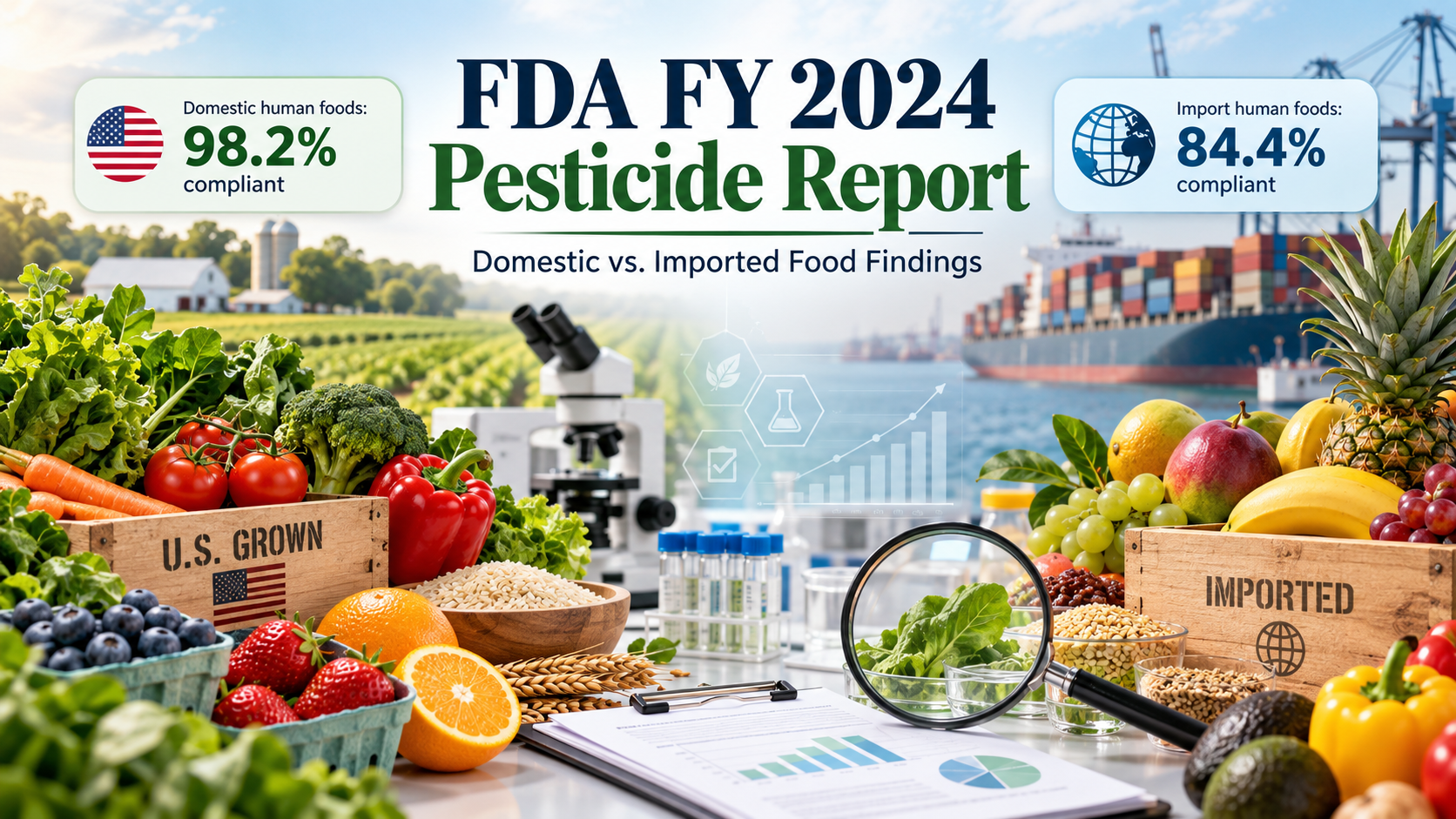
Executive summary
FDA and EPA have different regulatory roles. EPA establishes pesticide tolerances—the maximum amount of a pesticide residue legally permitted for a particular food—while FDA enforces those tolerances for most domestic foods in interstate commerce and imported foods. FDA’s program combines routine regulatory monitoring, focused sampling, and the Total Diet Study. fy24-FDA Annual Pesticide Report
For FY 2024, FDA analyzed 3,834 regulatory samples, consisting of 3,528 human food samples and 306 animal food samples. fy24-FDA Annual Pesticide Report.
| Category | Samples | Compliance | No detectable residues | Violative |
|---|---|---|---|---|
| Domestic human food | 893 | 98.2% | 36.8% | 1.8% |
| Imported human food | 2,635 | 84.4% | 36.5% | 15.6% |
| Domestic animal food | 153 | 93.5% | 47.1% | 6.5% |
| Imported animal food | 153 | 91.5% | 42.5% | 8.5% |
The most significant finding is therefore not simply the presence of pesticide residues. Roughly the same percentage of domestic and imported human foods contained no detectable residues—36.8% versus 36.5%. The major difference is whether the residues detected were legally permissible. Imported foods had an FY 2024 violation rate of 15.6%, compared with only 1.8% for domestic foods—almost nine times higher. fy24-FDA Annual Pesticide Report
Imported food is the principal compliance concern
The difference is evident across the major commodity groups:
| Commodity | Domestic violation rate | Import violation rate |
|---|---|---|
| Grains/grain products | 3.2% | 21.4% |
| Fruits | 0.4% | 13.3% |
| Vegetables | 2.8% | 16.8% |
| Other foods, largely nuts/seeds | 0% | 17.4% |
For imported foods, vegetables produced the largest number of violative samples: 223 of 1,328, or 16.8%. Imported grains had the highest major-category rate at 21.4%. fy24-FDA Annual Pesticide Report
FDA emphasizes, however, that these numbers cannot be interpreted as population-wide prevalence estimates. This is particularly important. FDA’s program is deliberately risk-targeted rather than random or statistically representative. FDA concentrates testing on commodities, origins and pesticide combinations with previous problems, high import volume, foreign pesticide-use information, regulatory intelligence and other risk factors. In FY 2024, 75% of samples were imports. fy24-FDA Annual Pesticide Report
Consequently, a 15.6% violation rate does not mean that 15.6% of all imported food entering the United States violates pesticide requirements. It means that 15.6% of the risk-targeted samples selected by FDA were violative. FDA specifically cautions that high violation rates for targeted commodities should not be interpreted as an overall violation rate for an exporting country. fy24-FDA Annual Pesticide Report
Most violations involve pesticides with no tolerance
This is, in my view, one of the most important regulatory findings in the report.
Among the 16 violative domestic human-food samples, 15 contained residues for which EPA had no tolerance for that pesticide/commodity combination. Among the 411 violative imported samples, 373 involved no-tolerance violations; 115 had residues exceeding an established tolerance, with some samples having both types of violation. fy24-FDA Annual Pesticide Report
FDA further states that the majority of import violations were no-tolerance violations, and approximately 80% of the violative residues were below 0.1 ppm. fy24-FDA Annual Pesticide Report
That distinction is important. A pesticide residue does not have to be present at a high concentration to create a regulatory violation. If EPA has not established a tolerance or exemption for that particular pesticide/commodity combination, a quantifiable residue can constitute a violation. FDA defines a no-tolerance violation as a residue at or above the LOQ where EPA has established neither a tolerance nor an exemption. fy24-FDA Annual Pesticide Report
This is fundamentally different from an over-tolerance violation, where use of the pesticide is permitted on the commodity but the measured residue exceeds EPA’s established maximum.
Imported commodities FDA identifies for special attention
FDA applied two criteria to identify imported commodities potentially deserving increased future sampling:
- At least 20 samples analyzed or at least three violations; and
- A violation rate of 10% or greater.
Several results are striking:
| Imported commodity | FY 2024 violation rate |
|---|---|
| Sour sour leaves | 100% |
| Prickly pear | 86.4% |
| Loroco flower | 80.0% |
| Cactus leaves | 50.0% |
| Cassava leaves | 50.0% |
| Cilantro | 43.8% |
| Kale | 42.9% |
| Pumpkin seeds | 42.9% |
| Spinach | 41.9% |
| Figs | 40.0% |
| Onions/leeks/scallions/shallots | 36.5% |
| Bok choy | 36.4% |
| Dates | 36.0% |
| Radishes | 33.3% |
| Mung beans | 29.1% |
| Peas | 28.6% |
| Rice | 27.9% |
| Olive oil | 25.9% |
| Limes | 21.6% |
Some very high percentages involve small sample sizes, so they should be interpreted cautiously. Rice, however, is notable because the rate was 27.9% across 165 samples, giving that result substantially more weight than a commodity represented by only three or five samples. fy24-FDA Annual Pesticide Report
Analytical capability—and an important limitation
FDA’s FY 2024 methods covered 781 pesticides and industrial chemicals. The majority—754—were covered by multiresidue methods, supplemented by selective methods for glyphosate/glufosinate and 27 acid herbicides. FDA detected residues of 215 different pesticides in human foods.
The most frequently detected in human foods included:
- Azoxystrobin – 427 samples
- Imidacloprid – 416
- Thiamethoxam – 304
- Fludioxonil – 283
- Cypermethrin – 268.
However, FDA explicitly acknowledges an analytical coverage gap: its methods detect approximately 78% of pesticides with current or revoked EPA tolerances. They also cover nearly 400 residues without EPA tolerances. Some pesticides with established EPA tolerances are therefore outside FDA’s current analytical scope, and FDA states that it does not know the extent of exposure to those pesticides in the foods it regulates.
That qualification is important when interpreting statements such as “no residues detected.” It means no residues among the substances covered by the analytical methods were detected above the applicable detection limit, rather than proof that absolutely no pesticide chemical was present.
Animal food
FDA tested 306 animal-food samples, equally divided between domestic and imported products. The violation rates—6.5% domestic and 8.5% import—were both above the FY 2018–2023 ranges.
Seventy-one different pesticide residues were detected in 169 of the 306 samples. Glyphosate was the most frequently detected, appearing in 63 samples, followed by malathion in 41 and piperonyl butoxide in 18. Only one of the glyphosate findings was violative.
FDA also conducted a separate focused assignment covering 110 domestically produced animal-derived foods: 29 milk, 34 shell eggs, 19 honey and 28 game-meat samples. No violative pesticide residues were found, and 93.6% contained no detectable residues.
Enforcement significance
The report is also useful from a regulatory-risk standpoint because FDA describes what can follow a pesticide violation. Domestic violations can result in Warning Letters, seizure or injunction. Imported food can be refused admission and products/firms can be placed under Detention Without Physical Examination (DWPE). Significantly, FDA states that DWPE may be based on a single violative shipment when that result creates an appearance of adulteration for subsequent shipments.
Once subject to DWPE, the burden shifts to the importer to demonstrate compliance before the goods can enter U.S. commerce. For removal from DWPE, FDA describes a general expectation of at least five consecutive non-violative commercial shipments supported by acceptable private laboratory analyses, together with an effective and detailed corrective approach addressing the original problem.
My main takeaway for a food-company risk system
For an importer or FSVP program, the most important message from this report is that pesticide risk should not be managed simply by asking whether a pesticide residue is below some generic numerical limit.
The relevant regulatory question is:
Is this specific pesticide legally permitted on this specific commodity, and, if so, is the residue below the EPA tolerance applicable to that pesticide/commodity combination?
The FY 2024 data strongly support that distinction because no-tolerance combinations—not merely excessive concentrations of authorized pesticides—account for most violations, particularly among imports. That makes pesticide authorization/use verification at the commodity × pesticide × country/grower level potentially more important to an importer than simply obtaining a generic certificate saying that a product “passed a pesticide screen.”
For your risk-management work, I would therefore identify three separate pesticide compliance hazards rather than treating “pesticide residue” as one hazard:
- Unauthorized pesticide/commodity combination → no-tolerance violation
- Authorized pesticide above its tolerance → over-tolerance violation
- Pesticide not adequately covered by the analytical/testing program → detection/verification uncertainty.
That structure fits the actual regulatory distinctions FDA uses in this report and would make a supplier or FSVP pesticide-control assessment considerably more precise.
Source: https://www.fda.gov/media/195051/download?attachment