

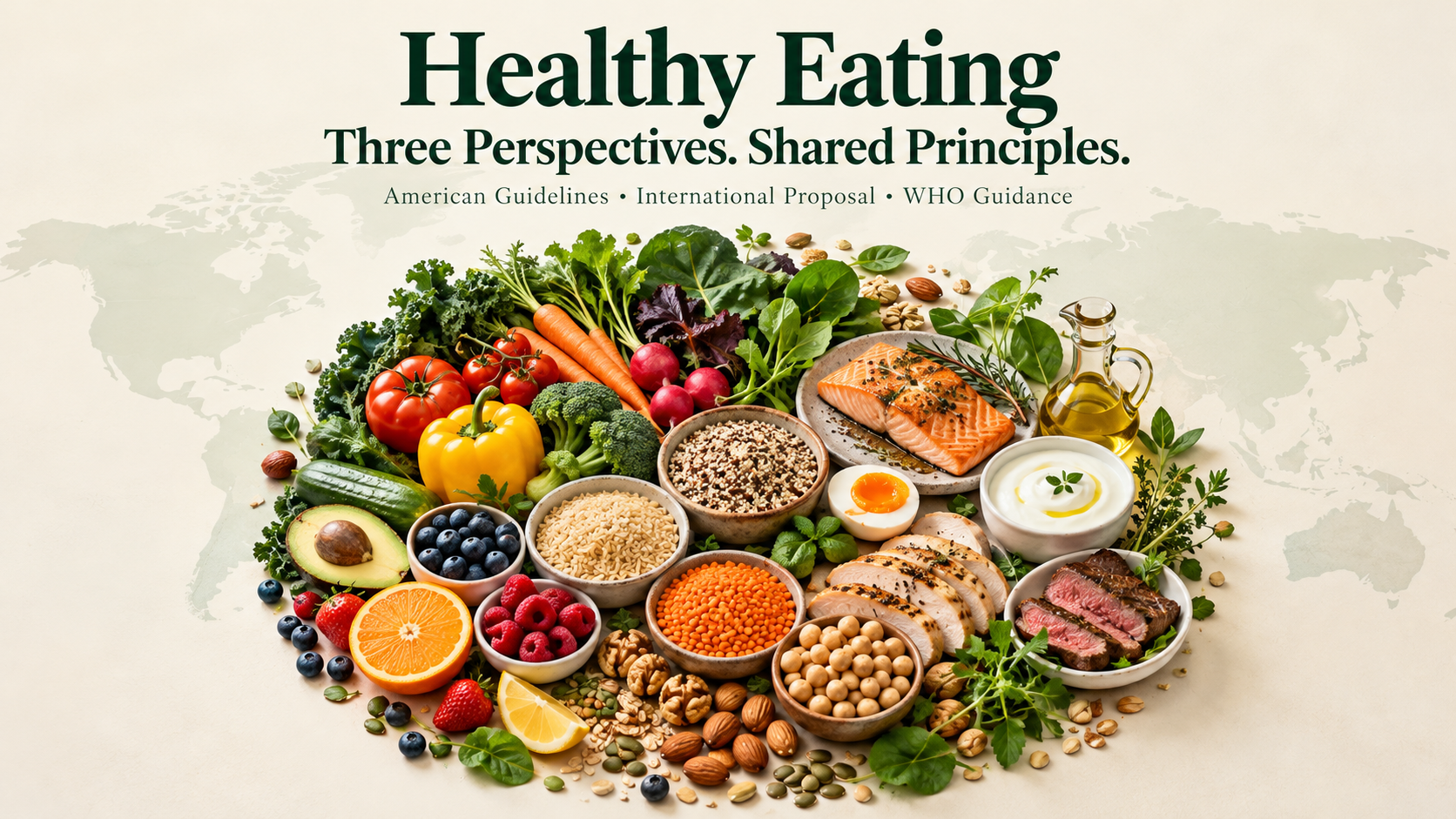
Healthy eating recommendations can appear contradictory. Should we eat more protein? Choose full-fat dairy? Limit carbohydrates? A comparison of the Dietary Guidelines for Americans, 2025–2030, the proposed International Food Guide Pyramid, and World Health Organization (WHO) guidance reveals substantial agreement, alongside differences that influence everyday food choices.
These references have different roles. The American guidelines establish national dietary policy. WHO provides global public-health recommendations supported by topic-specific guidelines. The International Food Guide Pyramid is a scientific proposal developed by researchers—not an officially adopted worldwide standard.
All three encourage varied, nutrient-rich diets containing vegetables, fruits, whole grains, and appropriate protein sources. They also support reducing sugary drinks, excess sodium, and foods with poor nutritional quality. Their principal differences concern the relative importance of animal foods, dietary fats, and carbohydrate quality.
The American guidelines recommend 1.2–1.6 grams of protein per kilogram of body weight daily, emphasizing protein at every meal. They include both animal and plant sources and recommend three daily dairy servings within a 2,000-calorie pattern, favoring full-fat products without added sugar.
The international proposal emphasizes legumes, nuts, seeds, soy, and other plant foods, complemented by modest amounts of animal foods. It favors fish and poultry over red meat and uses approximately one daily dairy serving as a reference. WHO similarly recognizes potential benefits from shifting toward plant proteins, particularly when they replace red meat, but does not adopt the proposal’s specific meat or dairy quantities.
Dietary fat presents a clearer disagreement. Although the American guidelines retain a saturated-fat ceiling of 10% of daily calories, they include butter and beef tallow as cooking options. The international proposal and WHO more explicitly favor replacing saturated fats with unsaturated oils. WHO also identifies reduced-fat dairy as one way to lower saturated-fat intake.
Carbohydrate quality is another important distinction. All three favor whole grains. The international proposal additionally emphasizes glycemic index, food structure, and traditional staples such as certain rice varieties and pasta. WHO focuses its recommendations on whole grains, vegetables, fruits, pulses, and naturally occurring fiber, specifying at least 25 grams of fiber and 400 grams of vegetables and fruits daily for adults.
Sugar terminology also matters. The American document focuses on added sugars, while WHO limits free sugars, a broader category that includes sugars in honey, syrups, and fruit juice. Therefore, “no added sugar” does not necessarily mean a beverage falls outside WHO’s sugar limits. The international article places greater emphasis on the food containing the sugar, particularly distinguishing sugary drinks from nutrient-containing solid foods.
For consumers, these comparisons support evaluating the whole dietary pattern: food variety, protein sources, fat quality, fiber, portions, and nutrient adequacy. For food businesses, they reinforce the value of product specifications that consider several nutritional characteristics together. A claim such as “high protein,” “plant-based,” or “no added sugar” describes only part of a product’s nutritional profile.
References
1. U.S. Departments of Health and Human Services and Agriculture. *Dietary Guidelines for Americans, 2025–2030.* [Official website](https://realfood.gov/).
2. Della Corte KA and colleagues. *Toward International Dietary Guidance: A Food Guide Pyramid for Human and Planetary Health.* [Read the article](https://www.sciencedirect.com/science/article/pii/S2161831326001523).
3. World Health Organization. *Healthy diet.* Updated January 26, 2026. [WHO guidance](https://www.who.int/news-room/fact-sheets/detail/healthy-diet).